Rethinking the Relationship Between Biodiversity and Agro Commodities Supply
CocoaMay 24, 20265 min read
Listen To Article5 min
Every year, the conversation around biodiversity conservation tends to settle into familiar territory: protected species, vanishing rainforests, the moral weight of what we are losing. These are real concerns. But for working in the cocoa and other agrocommodities industries, biodiversity is not an abstraction or a charitable cause running parallel to the business. It is core to the business. The pollinators, the soil microbes, and the shade canopy, are all production infrastructure of every agrocommodity we trade. When that infrastructure degrades, yields fall, costs rise, and supply tightens. The biodiversity loss story we are watching unfold across the world is a slow, expensive lesson in that fact.
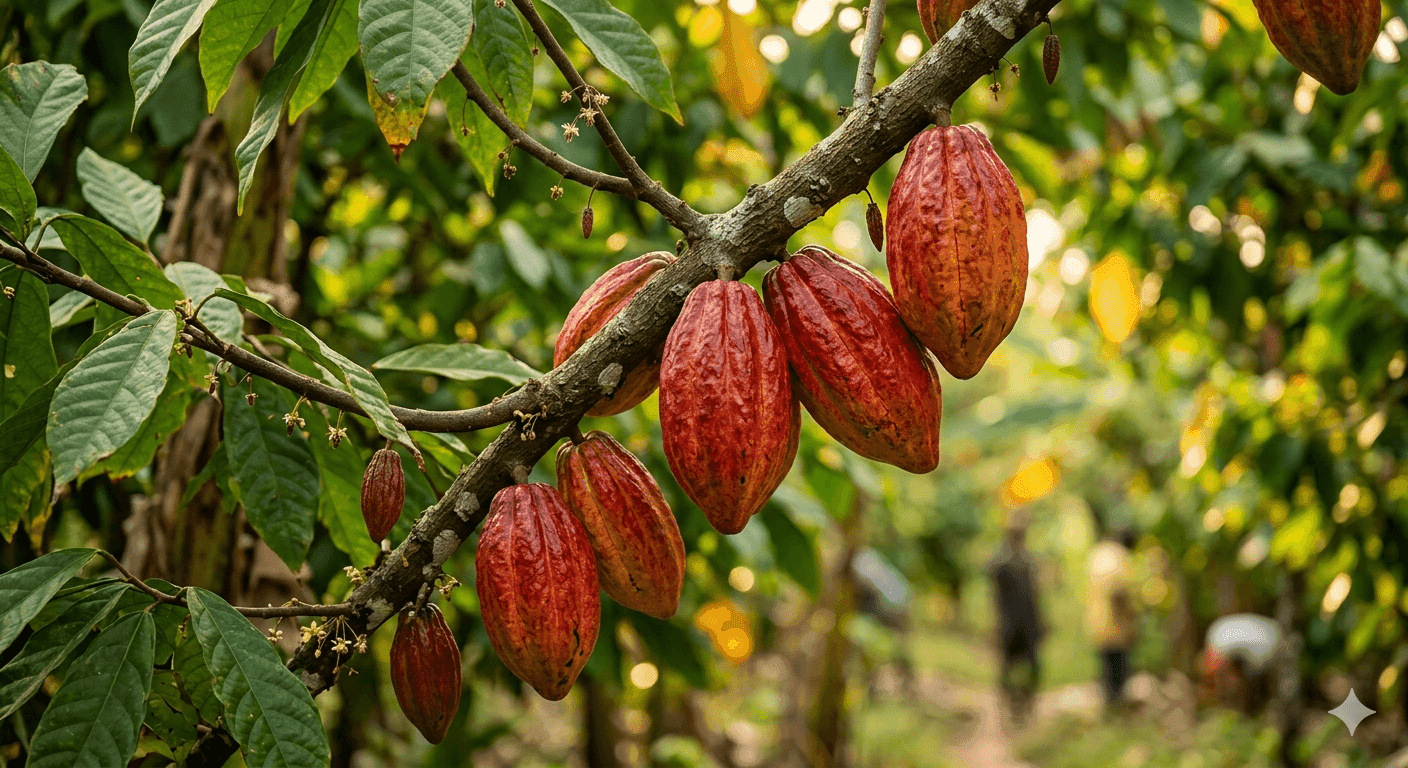
**Case in Point: What biodiversity loss actually does to a cocoa farm ** Cocoa is a forest crop. It evolved under shade, in soils built by decades of leaf litter and root networks, pollinated by tiny midges that depend on humid, decaying organic matter to breed. Strip away the surrounding ecosystem and you do not simply get a cleaner-looking farm. You get a less productive one.
The pattern is well documented. According to the Ivorian Forest and Fauna Inventory (IFFN, 2021), as cited in Frontiers in Plant Science (2025), Côte d'Ivoire's forest cover fell from roughly 16 million hectares in 1960 to under 3 million by 2020. Combined with climate change and disease problems, the result has been measurable declines in soil organic matter, depleted nutrient stocks, and increasing productivity erosion across the country's cocoa belt.
The mechanism is straightforward. Fewer trees mean fewer habitats for the wasps, spiders, and ants that suppress mirid bugs and pod borers. Less leaf litter means fewer cocoa pollinators, which means fewer pods set per flower. Exposed soil bakes, loses carbon, and stops holding water. Each of these is a yield problem before it is anything else. A farmer whose soil is dead and whose canopy is gone is not just an environmental story, they are a sourcing risk.
**Agroforestry as a Solution. ** Field research from Ghana by Blaser and colleagues, published in Nature Sustainability (2018) shows that low-to-intermediate shade agroforestry systems support cocoa production, while delivering carbon storage, climate resilience, and biodiversity gains at the same time.
The logic is practical. Shade trees moderate temperature during the increasingly brutal dry seasons. Diverse canopies host the natural predators that keep pest populations in check, reducing reliance on agrochemicals. Root systems and leaf litter rebuild the soil organic matter that monocultures spend down. And on the carbon side, agroforestry plots sequester far more than full-sun farms.
Properly designed agroforestry, in other words, is one of the few interventions in cocoa that genuinely aligns environmental performance and productivity. It goes beyond charity, into risk management with added benefits.
**EUDR Doubling as a Biodiversity Regulation ** The EU Deforestation Regulation, — Regulation (EU) 2023/1115, which takes binding effect for large and medium operators on 30 December 2026 (with small operators following on 30 June 2027), is most often discussed as a deforestation rule. It is. But it is also, in practical effect, one of the most consequential biodiversity instruments ever applied to the cocoa trade, even if biodiversity is not the word on the cover.
Here is why. To place cocoa on the EU market, operators must provide plot-level geolocation data proving the product did not originate from land deforested or degraded after 31 December 2020. That single requirement does several things at once: it freezes the forest frontier, it forces traceability down to the farm, and it makes the conversion of biodiverse landscapes commercially unviable for anyone who wants EU buyers. Forest degradation, not just clearance, is in scope, which means the regulation indirectly protects the canopy structure, habitat continuity, and species mix that biodiversity depends on. The EU itself frames the EUDR as a direct outcome of its broader biodiversity strategy under the European Green Deal, and that framing matters: enforcement is not only about trees, it is about the ecosystems trees anchor.
For sourcing partners, this means a deforestation compliance file is, by definition, also a biodiversity file. The geolocation data, the land-use history, the legal-sourcing verification are all important evidences. Treating EUDR purely as a paperwork exercise misses the strategic opportunity to build a sourcing footprint that is genuinely defensible on multiple fronts.
**What SFI Agri requires of its sourcing partners ** At SFI Agri, our position is straightforward: we work with sourcing partners that can account for the ecological condition of their supply origins .
Not only are we prioritizing EUDR compliance, we support progressive adoption of agroforestry practices: meaningful shade-tree integration, native species where possible, and management plans that treat the farm as part of a wider landscape, not an island.
These are not aspirational principles tucked into a sustainability report. They shape our business priorities.
**A healthy ecosystem is a benefit to the supply chain.
**
It is easy to reduce biodiversity concerns as a cost center, something to be balanced against productivity and addressed once the core business questions are settled. But that framing is defective. The effects of biodiversity loss tell on the supply chain’s productivity. Yields decline when pollinators disappear and soils lose ability to nurture. Prices also increase when supply drop due to lower yield.
On the other end, market access tightens without EUDR/RA. Insurance, finance, and offtake increasingly depend on ecological and compliance evidence that were once considered optional.
The companies that will still be sourcing agro commodities profitably in the next few years are the ones that are rebuilding ecosystems on the farms they buy from today. Not just because it is ethical, but because the supply chain’s future depends on it.
As we recognize the increasing need for biodiversity conservation, the question worth asking is not whether your supply chain is doing enough for biodiversity. It is what you are willing to invest to make sure biodiversity preservation is prioritized.
More News
Uncategorized
In Defense of the Bean: Why Natural Cocoa Is More Than a Commodity
We Are Trusted And Reliable
Whether you have questions, need more information, or want to explore business opportunities, our team is here to help.